⚠️ The times mentioned here are occupation times, which are one hour ahead of those in England ⚠️
The First Sighting
Around 3:15 p.m., Hermann Kirst, a German soldier stationed in Het Leuven (Groessen), southwest of Zevenaar, sees a heavily damaged American B-17 “Flying Fortress II” approaching from the north. Three of its four engines are out; only the left outer engine is still sputtering along. The aircraft is flying low. Kirst hears the distant rumble of anti-aircraft fire and watches as the bomber slowly drifts toward Millingen on the Rhine.
The First Fire
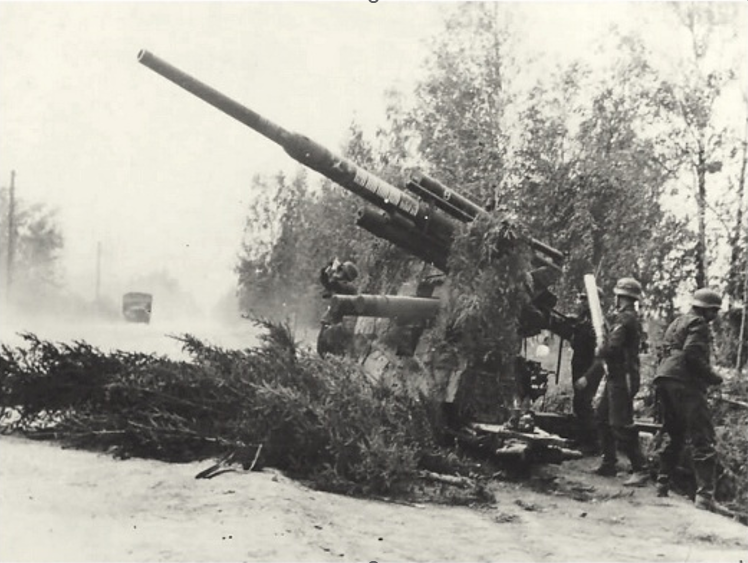
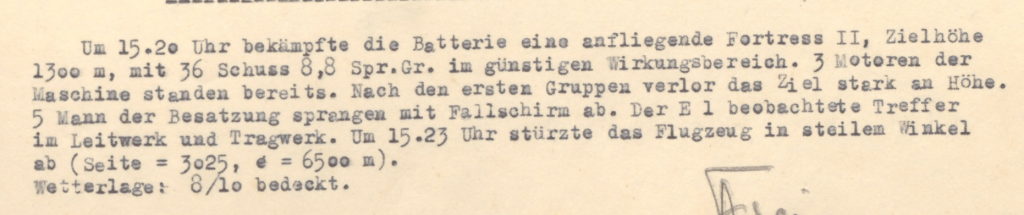
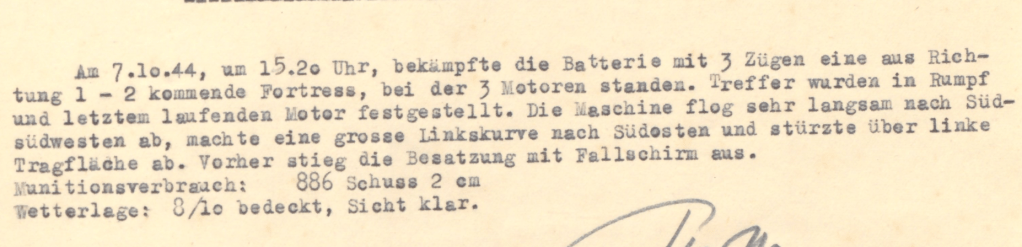
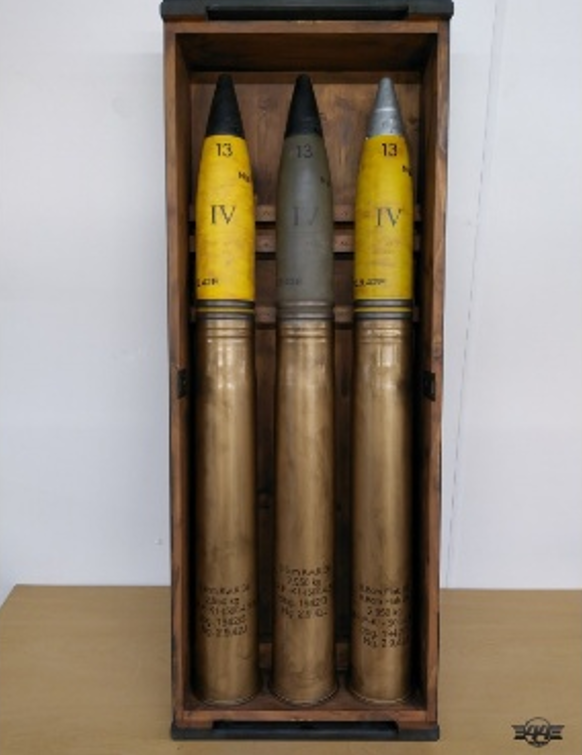
At approximately 3:20 p.m., the anti-aircraft batteries of Flakabteilung 572 (b-mot) open fire with their heavy 88mm guns. Within seconds, the sky fills with tracer shells. According to the report of the battery commander, 36 shells are fired to an altitude of about 1,300 meters. The first hits are soon reported: the left outer engine is struck, and the fuselage and wing sustain multiple impacts.
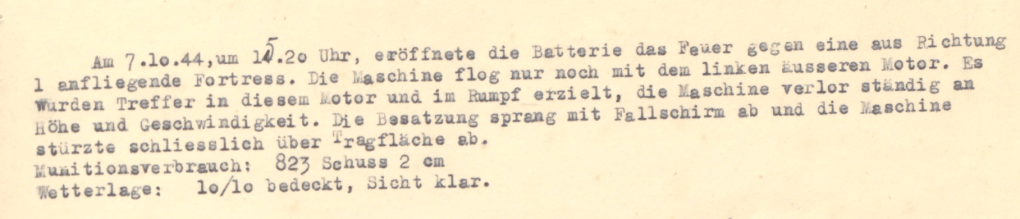
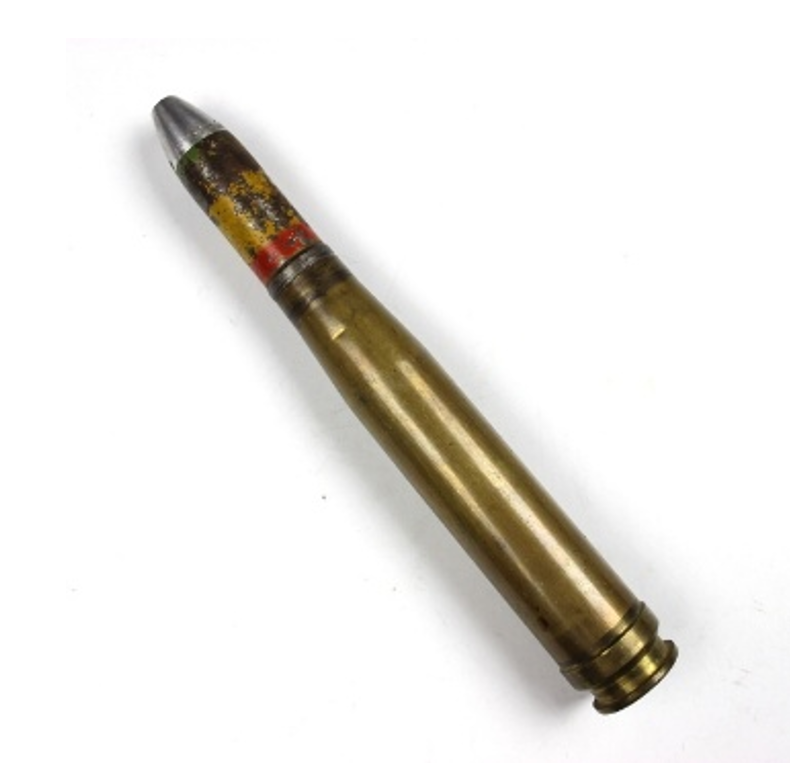
At the same time, Flakabteilung 345, equipped with 2 cm guns, also reports hits on the same bomber. In total, they fire 886 rounds. Their report confirms that the aircraft had only one functioning engine left and gradually lost altitude after being hit. The plane makes a sharp turn to the left a desperate maneuver by the pilot to stabilize the bomber’s glide.
The Decisive Attack
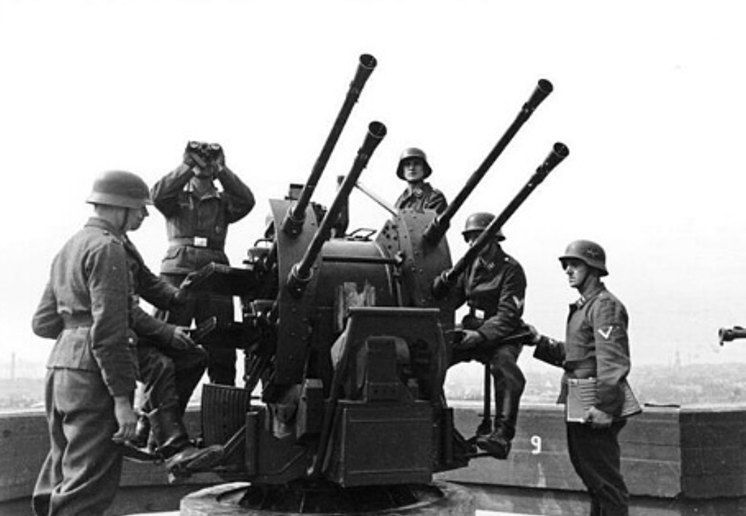
Meanwhile, Flakabteilung 598 also opens fire. Their 20mm guns unleash no fewer than 1,296 rounds toward the Fortress. One of these bursts hits the engine again, which now bursts completely into flames. Soldiers on the ground watch as five parachutes open five crew members have bailed out of the stricken aircraft.

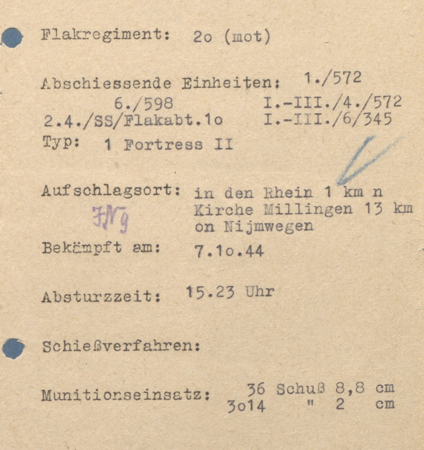
Still, the aircraft remains in the air for a few more seconds like a wounded animal refusing to go down. Then comes the final turn to the left. The B-17 rapidly loses altitude and crashes at 3:23 p.m., about one kilometer north of the church of Millingen, into the Rhine. The amount of ammunition fired at the Fortress II was recorded with great precision: 36 rounds of 88mm and 3,014 rounds of 20mm
Paperwork of a Downed Enemy Aircraft
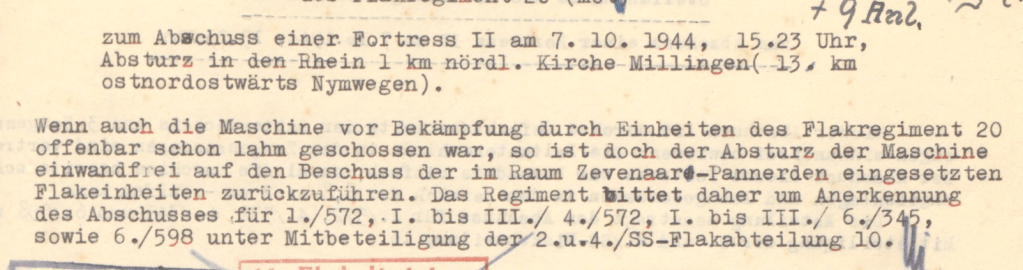
In the days following the crash, the event is documented in German reports. Flak Regiment 20 drafts an official request for recognition of the victory. This document lists all the units involved:
• 1./572
• 4./572
• 6./345
• 6./598
• 2.4./SS-Flakabteilung 10
The regiment emphasizes that the aircraft was without a doubt brought down by their concentrated fire. The reports include stamps, signatures, and even hand-drawn maps detailing the flight path and crash location.

Hand drawn map
Eyewitness Reports
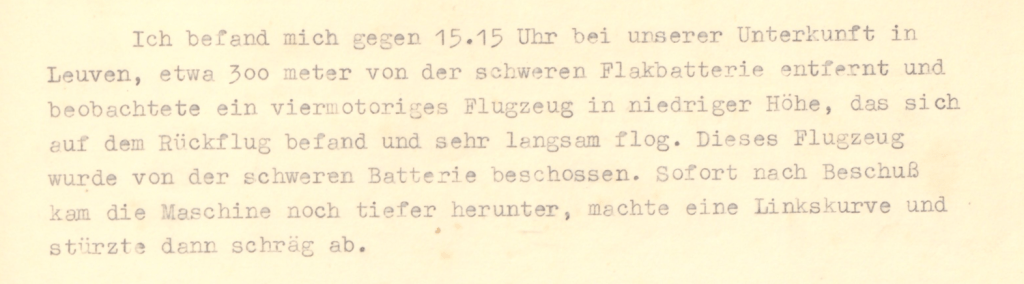
Ogfr. Hermann Kirst (Witness 1) later describes how he saw everything unfold from 300 meters away from an anti-aircraft battery:
“I saw the four engine bomber catch fire after the first shots. It flew lower and lower, made a sharp turn to the left, and then disappeared behind the horizon. Shortly afterward, a black cloud of smoke rose.”
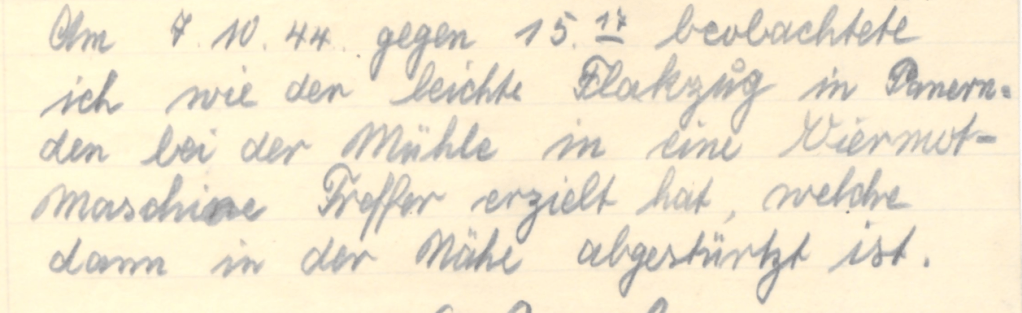
Stabsarzt Dr. Vyslougil (Witness 2):
“On October 7, 1944, around 3:17 p.m., I saw the light anti-aircraft guns by the mill in Pannerden hit a four-engine aircraft, which then crashed nearby.”
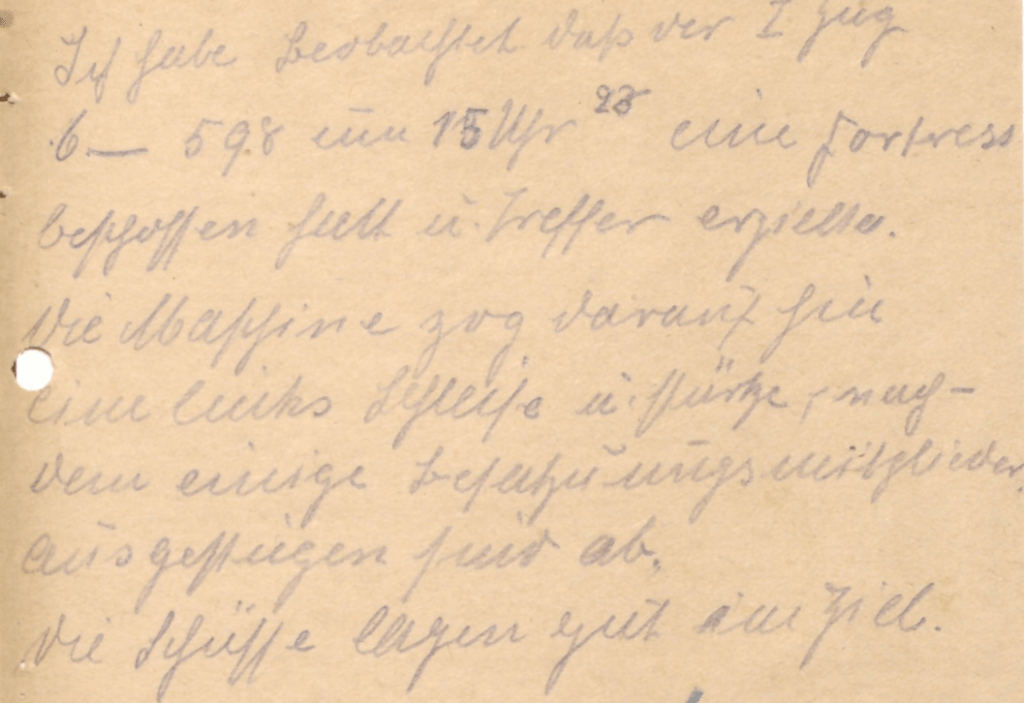
Ofw. Luider (Witness 3):
“I saw I. Zug 6-598 fire at a Fortress at 3:28 p.m. and hit it. The plane then made a turn to the left and crashed after several crew members had parachuted out. The shots were well aimed.”
The five crew members who escaped by parachute were taken prisoner shortly after the crash. What happened to the remaining crew members remains unclear.
The division’s seventh victory
On October 16, 1944, the event is officially confirmed. The shooting down of this Fortress is recorded as the division’s seventh victory. The documents are forwarded to the Oberkommando der Luftwaffe, where this victory is officially entered into the records.

Source:
© Bundesarchiv Freiburg
 Millingen in oorlogstijd