In April 1943, a massive strike broke out in the Netherlands, quickly spreading across the country. It began on April 29 at the machine factory “Gebroeders Stork en Co.” in Hengelo, where workers stopped working in protest against the German occupier. The immediate cause of the strike was the announcement that Dutch men, including former soldiers who had fought in 1940, would be forced to go to Germany for the Arbeitseinsatz.
Because the occupier forbade news about the strike, the message spread mainly by word of mouth. This is how the news also reached Millingen. The strike, which originally began in Hengelo, grew into one of the largest acts of resistance in the Netherlands during the Second World War. It was a powerful signal of defiance against the German occupation and the forced labor transport to Germany. Despite the threat of violence and reprisals from the occupier, the strike spread to other cities and factories in the country.
Strike at the Shipyard.
During the night of April 30 to May 1, 1943, a placard was hung on the yard fence with the message: “Dutch, stop your work, for unity is strength.” The next morning, Saturday, May 1, the people who went to work knew exactly what to do: strike. Most of the people who worked at the yard went home, except for a few NSB members and pro-Germans. The strikers received support from the shipyard’s payroll administrator, who ensured that all employees were recorded as present, making it difficult for the occupier to track who had or had not participated in the strike. A local NSB member saw the placard and reported it to the Germans. A raid vehicle with SS members arrived, among them Gerhard Wanders, a notorious Jewish hunter from Nijmegen. The Germans knew who was behind the strike, but deputy director Nol Arntz remained determined and refused to be intimidated. Even when a pistol was pressed against his chest, he stayed loyal to the strikers and refused to betray who was behind it.
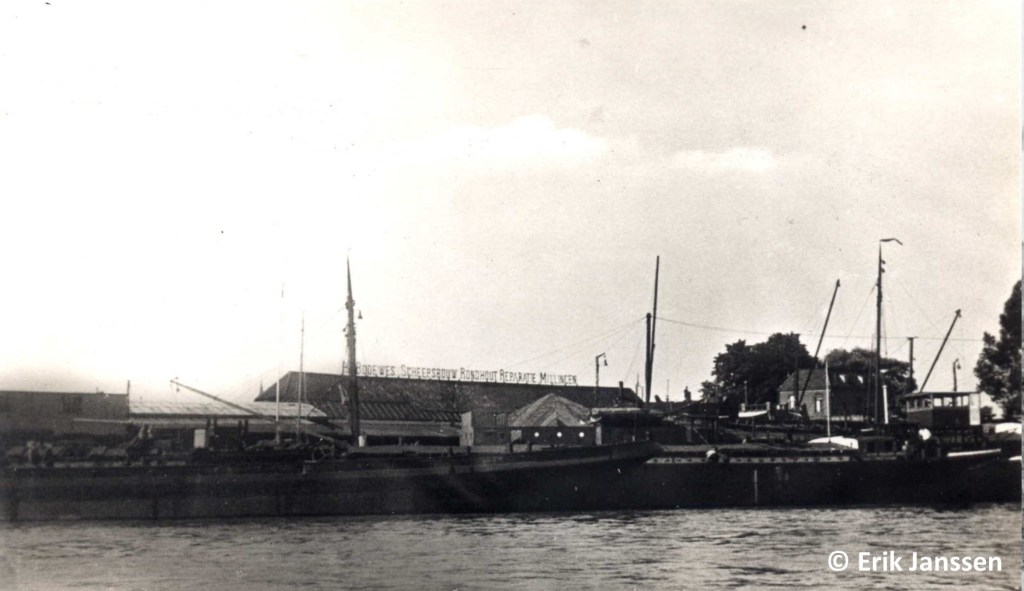
At eleven o’clock, work had to be resumed at the yard. Arnold Hendriks writes in his wartime diary how it went: “When I arrived at the yard, the SS was standing with rifles at the ready. I didn’t need to walk anymore, but was simply pushed upstairs. In the office of director Juus Arntz, I greeted him with ‘Good afternoon,’ upon which I received a hard slap in the face from a Dutch policeman. I should have been standing at attention for the German officers. The torn placard from the fence was lying on the table, and I was blamed for putting it up. I hadn’t done that. In any case, they saw me as an agitator. An SS officer said I had to come to Nijmegen. There, I would be shot. Meanwhile, two more men were picked up. Toon Scholten (he always laughs, Toon was born laughing) had supposedly laughed at the SS, Piet Reijmers wanted to report sick at the office. The Germans said to him: ‘You have the English disease, come with me to Nijmegen.’ So we went between two SS members to the Ridderstraat police station. On Sunday morning, the police came to get us from the cell again. We got our things back and briefly hoped we could go home. That was not the case. They let us get some air in the courtyard. Then a bus arrived with nine people from Lobith and six from Millingen. We had to get in. The bus took us to the Vught concentration camp. Toon Scholten was interrogated first. He received a few hard blows and was detained. After three months, they released him again. The placard that had hung on the yard’s fence had been glued back together.1 I was blamed for it. I insisted I had not done it. After a few blows to the face, I couldn’t see anything anymore.”
On May 19, 1943, six of the nine men were released. The decision to release these six men was made on May 15 by the SS. At the same time, it was decided that Hent Cronenberg and Arnold Hendriks would be punished longer. They only returned to Millingen on June 12.
Strike at the Light Bulb Factory.
The light bulb factory at Rijndijk 22, owned by the Van der Velden family, also took part in the national strike. This was an enormous risk for them, as they had Jewish people in hiding in their home next to the factory.
Hent van der Velden writes after the war how it all happened: “At the general strike on May 1, 1943, we decided to join in. We were just listening to the English radio station when I suddenly saw German raid vehicles coming. In no time, the dyke was full of SS members, and they were already at our door. My father wanted to quickly turn off the radio, but grabbed the wrong knob. We yanked out the cord. Luckily, the soldiers hadn’t heard anything due to all the ‘commotion,’ because it was loud—roaring engines, shouting orders from commanders, the tramp of boots from running soldiers. A few ‘death heads’ came down the dyke and banged on the door. I called out to my sisters that I was in the back of the shop and had already opened the door. In a flash, they had me, a revolver pressed to my chest, finger on the trigger. He shouted: ‘Where are the workers?’ I turned white as a sheet. Within three-quarters of an hour, they must be working here again, or else you’ll go into the Rhine. To make matters worse, Aunt Elly came to visit us too. She had twenty Jews hidden in Amsterdam. She had to show her ID card. Fortunately, she had the right one with her. She was allowed ten minutes inside. Mr. Halberstadt (one of the Jewish people in hiding at Van der Velden) said when she came in: ‘Go back quickly, otherwise we’re done for too.’”2 Everything went quietly afterwards.
Notes:
1: Stichting Margot van Boldrikfonds, Arnold Hendriks oorlogs herinneren.
2: Stichting Margot van Boldrikfonds, Familie van der Velden.
Source: Stichting Margot van Boldrikfonds.
 Millingen in oorlogstijd
Plaats een reactie