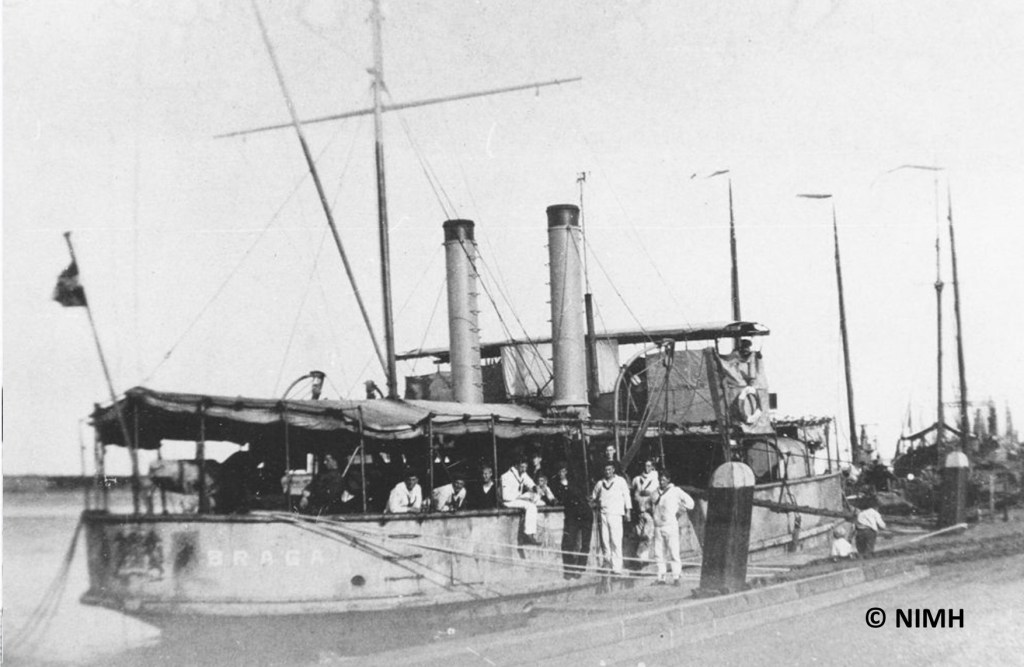
Hr. Ms. Braga in Millingen.
During the mobilisation of 1939, Hr. Ms. Braga came to provide reinforcement to the Investigation and Surveillance Service Upper Rivers. The home port of Hr. Ms. Braga became Millingen (on the Rhine) and her task was to guard the border and, if necessary, to intervene.
German activities around the Rhine.
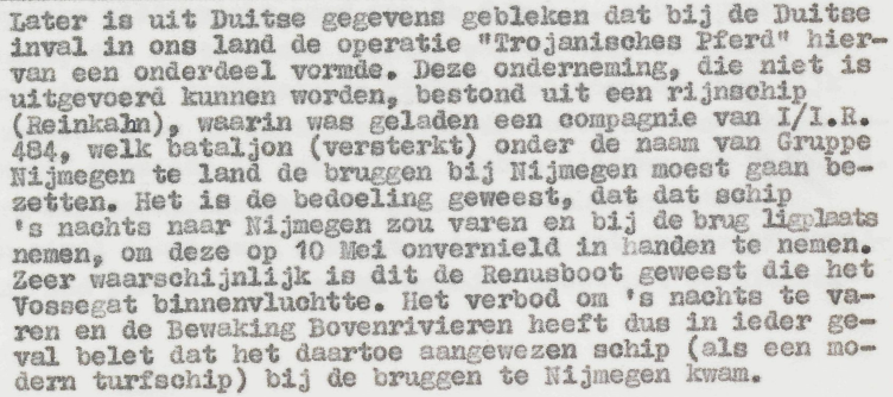
On 9 May 1940 at 23:45 hours, Hr. Ms. Braga was informed that shipping on the Waal, Bijlandschkanaal and Pannerdenschkanaal was blocked for the entire night. Fifteen minutes later, the order was given to Hr. Ms. Braga to hold position to the utmost in the event of border crossings at post Pannerden, Millingen. On 10 May at 03:35, the commanding officer, Lieutenant at Sea 1st Class Uiterwijk of Hr. Ms. Braga, saw dozens of German aircraft fly over them. He immediately reported the aircraft. A few minutes later, he was told that Hr. Ms. Braga was to be brought to combat readiness. Shortly afterwards, they saw a ship “Renusboot” that tried to go downstream, but when the M10 (Defence Motor Sloop) approached, the ship fled into the Vossegat. Shortly thereafter, 1st Lieutenant Uiterwijk received the report from the Marechaussee that Millingen was occupied by the Germans.



The attack on Braga.
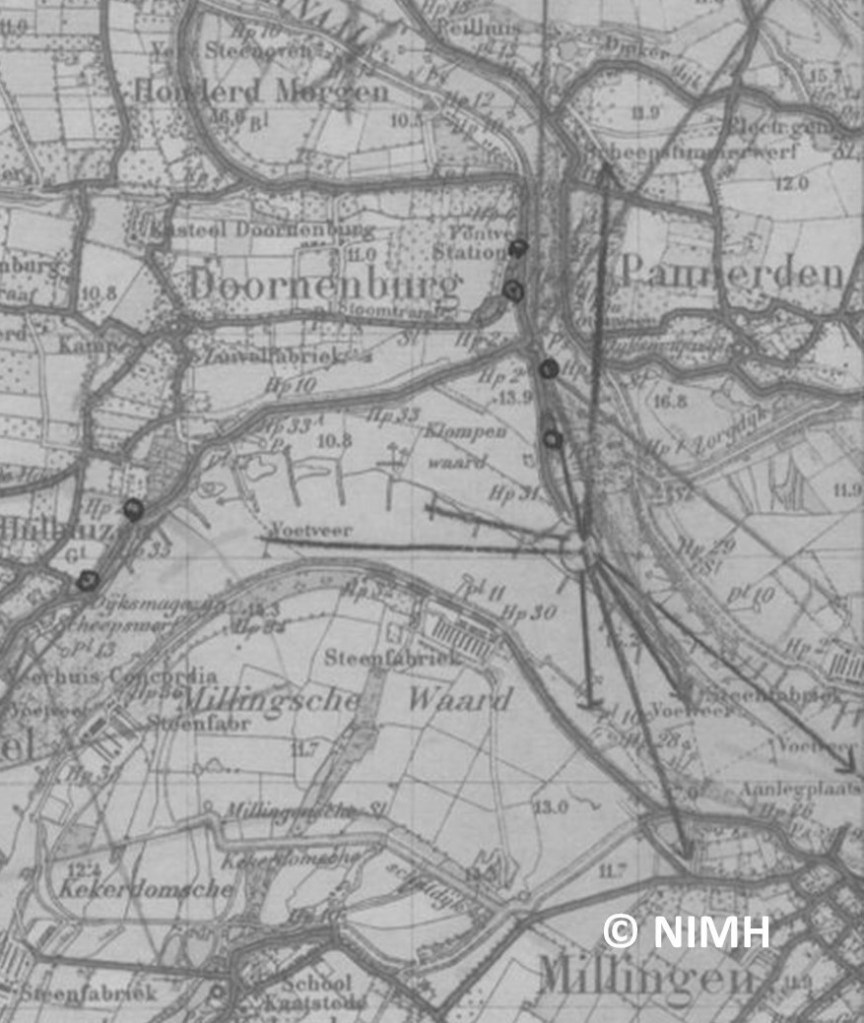
After 1st Lieutenant Uiterwijk had observed the Germans advancing from Millingen, the Germans opened fire from the dike on Hr. Ms. Braga. Uiterwijk also saw how, on the opposite bank near Pannerden, German armoured vehicles were firing at the casemates. For tactical reasons, 1st Lieutenant Uiterwijk decided at 08:00 hours to go down the Waal until directly behind Fort Pannerden. Between two groynes, Hr. Ms. Braga was run aground. They let water into the ship, which rendered the 120 mm gun inoperable. 1st Lieutenant Uiterwijk left the ship together with his crew. They took a 37 mm gun, a 12.7 mm machine gun and as much ammunition as possible to the fort.

Carrying out the task further on land.
The crew of the Braga reported to Fort Commander Westerveld. Due to the shelling, all above-ground telephone lines had been destroyed and could not be repaired. Meanwhile, the guns at the fort were manned. Suddenly, a German patrol was spotted at Millingen and Sailor 2nd Class Joseph Valkenburg immediately responded. While the German patrol boat was being fired at, it hid behind ships anchored at Millingen and sailed back to Lobith. A total of three shots were fired at the patrol boat. All three missed, but a rowing boat lying at Millingen was hit. Early in the evening, Fort Commander Westerveld received the report from patrols that Millingen and Pannerden were fully occupied, and Doornenburg was half occupied by the Germans. In the evening there was little shooting, so Westerveld ordered as much rest as possible from the first heavy day, but of course with the necessary vigilance.
The second day of the attack.
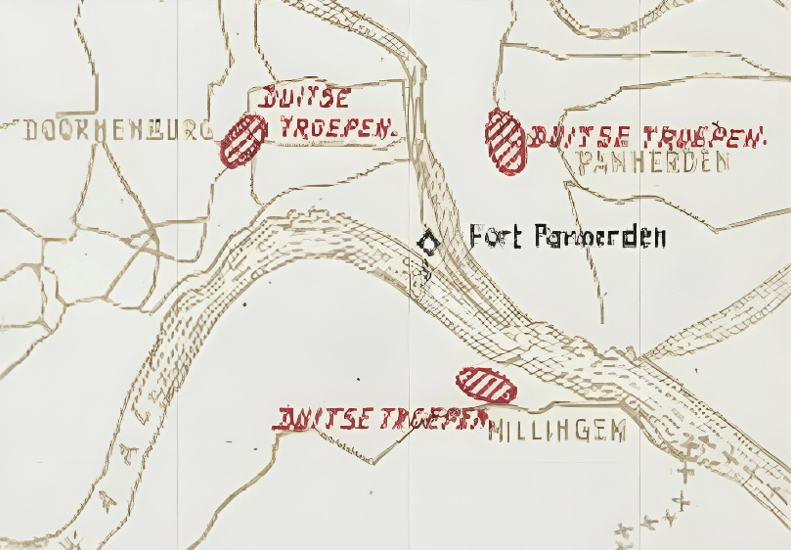
On 11 May 1940 at 02:30 hours, all posts at the fort were again manned for a possible new attack by the Germans. As soon as it began to get light again, the first large numbers of German aircraft came over the fort further into the Netherlands. It was also quickly seen that there were German troop movements on the other side of the Pannerdenschkanaal and the Waal. At Millingen an exit position was suspected. Around 08:00, about half a dozen German aircraft appeared above the fort. The aircraft began dive attacks, firing at the fort with their on-board weapons. The heavy machine gun from the Braga had been placed on top of the fort, with Marine Jan van Rijn opening fire on the aircraft. At least one aircraft was badly hit and flew back towards Germany. After the attack by the aircraft, Captain Westerveld gave the order to only fire at aircraft if they were firing at the fort from a short distance. This was to save as much ammunition as possible. Many patrols were carried out from the fort, in which the crew of the Braga also participated. In one of these patrols, Sailor Naval Militiaman Piet Pes did not return. Probably his retreat was observed by the Germans. At 15:00 hours, a patrol from Doornenburg returned with the report from Lieutenant V. Son that Doornenburg was completely occupied by a strong force. They were now setting up artillery and mortars towards Fort Pannerden.
Surrender of the Fort.
At 18:45 hours, two German negotiators came to Fort Pannerden. One of them was called Oberleutnant Dr. Speck, who immediately gave an ultimatum to 1st Lieutenant Ten Haken. Captain Westerveld sent 1st Lieutenant Ten Haken to conduct the negotiation. The message from Oberleutnant Dr. Speck was as follows:
“I must demand the fort immediately. If it is not handed over without a fight, then we will have to take it by force. You will then be shelled with heavy artillery, which is already in position, and with Stukas. Our tanks for the assault are ready. You are completely surrounded; the entire hinterland is in German hands: the Meuse has been crossed, resistance is completely useless. We are in radio contact with our aircraft. We do not come as enemies and therefore want to avoid unnecessary bloodshed.”
1st Lieutenant Ten Haken replied that he could not make a decision on this and asked for a postponement until 19:30 hours. Oberleutnant Dr. Speck agreed to this. Captain Westerveld immediately convened a council of war with Reserve 1st Lieutenant Ten Haken, Lieutenant at Sea 2nd Class J.H. Uiterwijk and Lieutenant at Sea 3rd Class F.P.A. Jamin, both from the Braga. The situation did not look good. The fort was completely surrounded from Millingen, Doornenburg and Pannerden. They quickly concluded that they were in a completely hopeless position and that from a military point of view it made no sense to continue fighting. On 11 May at 19:30 hours, Fort Pannerden was surrendered to the Germans after a brave fight. The troops were allowed to remain in the fort until 12 May and were then taken via Nijmegen to Germany.
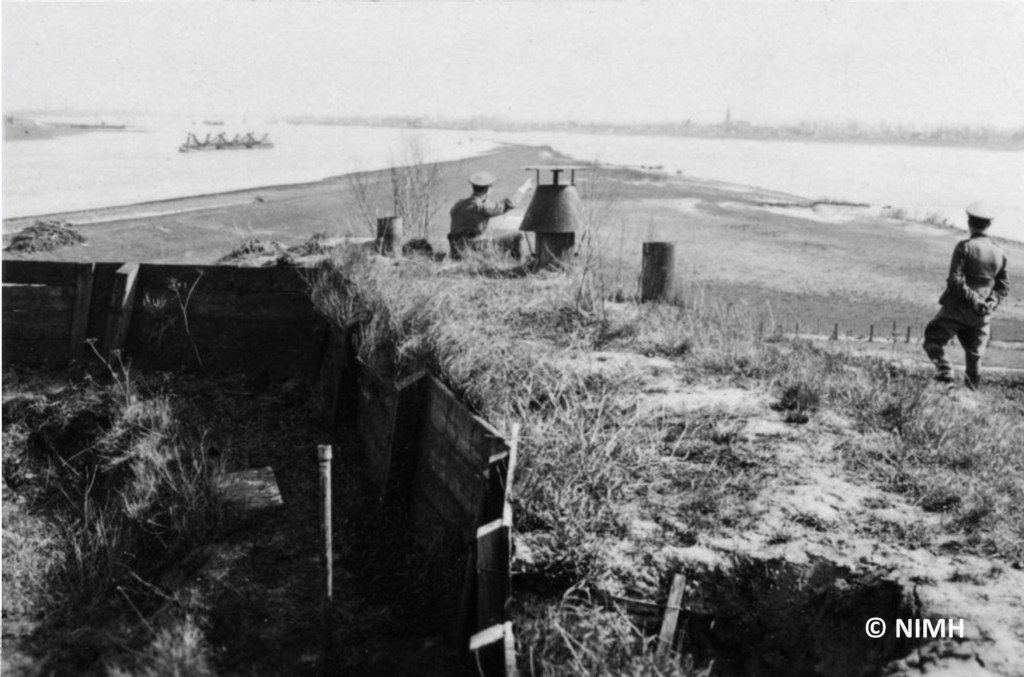
Source: NIMH.
 Millingen in oorlogstijd
Plaats een reactie